The Measured Blow: How Cadence and Deliberate Pause Transform the Act of Making
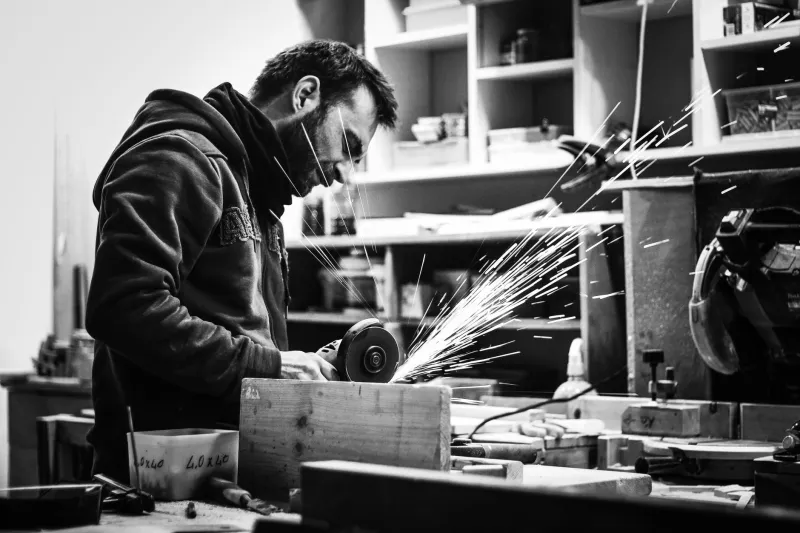
There is a moment, familiar to anyone who has stood beside a working forge or watched a seasoned woodworker address a difficult grain, when the shop goes quiet. Not silent in the way an idle room is silent, but quiet in the way a held breath is quiet—charged, deliberate, full of calculation. The craftsperson pauses. Studies. Then acts.
That pause is not wasted time. It is, in many respects, the most productive moment in the entire sequence.
In an era that prizes throughput above nearly all else, the rhythmic pace of handcraft can appear, at first glance, like an anachronism—a charming but impractical inheritance from a slower world. Look more carefully, however, and a different picture emerges. The cadence of skilled hand work is not the absence of efficiency. It is efficiency operating on a longer timeline, toward a more durable result.
The Language of Repetition
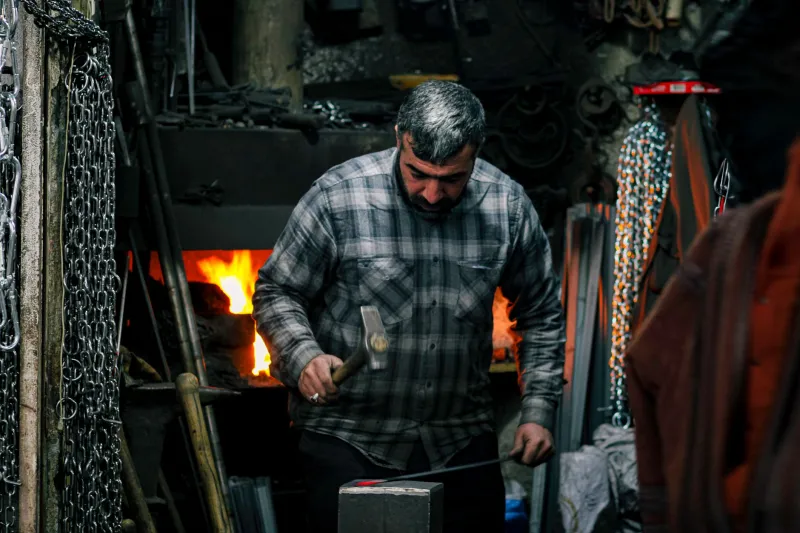
Every craft tradition carries within it a physical vocabulary built from repetition. The blacksmith does not simply strike metal; he strikes in a pattern, adjusting pressure and angle with each blow, reading the material's response the way a musician reads a room. The furniture maker does not simply plane a surface; she works in measured passes, pausing to sight down the board, to feel for variance with a flattened palm. These are not arbitrary habits. They are accumulated wisdom encoded into physical movement.
Anthropologists who study skilled labor have long observed that master craftspeople develop what researchers sometimes call tacit knowledge—understanding that cannot be fully articulated in language but is expressed precisely through the body's learned rhythms. A journeyman cooper in Vermont, asked why he taps a barrel stave three times before setting it, may struggle to explain the reasoning. But those three taps are diagnostic. They tell him, through sound and vibration, whether the wood is seated correctly. The ritual is the intelligence.
This is the first lesson the cadence of craft teaches: that some forms of knowing cannot be accelerated without being destroyed.
Pace as Problem-Solving
Industrial manufacturing resolves problems by standardizing them away. If a material behaves inconsistently, the process is engineered to eliminate the inconsistency—or the material is replaced with one that conforms more reliably. The goal is a frictionless flow where variation is the enemy.
Handcraft operates by an opposite logic. Variation is not the enemy; it is the text. When a smith pauses between strikes, he is reading what the last blow revealed. When a leather worker slows her stitching at a corner, she is responding to what the material is telling her about tension and flex. The pause is not interruption—it is inquiry.
This responsive relationship between maker and material produces something that standardized processes rarely achieve: solutions that are genuinely fitted to the specific object being made. A handcrafted knife blade, shaped through hundreds of individually considered hammer blows, reflects the particular properties of that bar of steel on that day under those conditions. The maker's rhythm accommodated the material's reality. The result is an object that, in a very real sense, could not have been made any other way.
In problem-solving terms, this is what psychologists call adaptive expertise—the capacity to recognize when a situation requires deviation from established procedure and to respond with calibrated judgment rather than rote execution. The measured pace of handcraft is, among other things, a training ground for exactly this kind of thinking.
The Forge and the Mind
Craftspeople across disciplines frequently describe their work in terms that edge toward the contemplative. This is not romantic exaggeration. The repetitive, rhythmic nature of skilled manual labor creates neurological conditions that researchers associate with focused attention states—what psychologist Mihaly Csikszentmihalyi famously termed flow. Heart rate steadies. Peripheral noise recedes. The maker exists, for a time, in a present tense that is unusually complete.
What is less often discussed is what this state does for resilience. The craftsperson who has spent years working through difficult materials, through failed heats and split wood and leather that refused to cooperate, develops a particular tolerance for resistance. The rhythm of the work teaches, implicitly and repeatedly, that difficulty is not a signal to stop. It is a signal to slow, to observe, and to adjust. The pause between strikes is not defeat. It is strategy.
This quality—call it patient persistence, or calibrated tenacity—is increasingly rare in professional and creative life more broadly. We are surrounded by tools and platforms that promise to eliminate friction, to deliver results without the educating resistance of genuine difficulty. What is lost in that bargain is the very capacity that difficulty builds. The craftsperson who has learned to read a recalcitrant piece of iron carries into every subsequent challenge a confidence that was earned, not assumed.
Ritual as Quality Control
In the American craft tradition, ritual often gets dismissed as superstition or affectation—the quirky habits of people who have spent too long alone in workshops. This is a misreading. The ritualistic movements of skilled craft are, in most cases, quality-control mechanisms so well integrated into physical practice that they no longer register as deliberate checks.
The bladesmith who cools a blade in a specific sequence, who examines the hamon line from a specific angle under a specific light, who applies the edge test in a specific order, is not performing theater. He is running a diagnostic protocol refined over years of consequence—of blades that held and blades that failed and the slow accumulation of understanding about why. The ritual is the record of everything that went wrong before, institutionalized into habit so it does not go wrong again.
This is one of the reasons handcrafted objects, made by experienced practitioners, tend to exhibit a consistency of quality that is difficult to explain purely in terms of technique. The technique is inseparable from the ritual that surrounds and governs it. Strip away the measured pace, the deliberate pauses, the repeated diagnostic gestures, and you do not simply make the same process faster. You make a different process—one that lacks the embedded checkpoints that distinguish acceptable from excellent.
What Speed Cannot Purchase
There is a phrase sometimes used in American manufacturing circles: good, fast, cheap—pick two. It is a useful heuristic, but it understates the real cost of choosing fast. Speed does not merely trade quality for time. At the level of handcraft, speed trades away the conditions under which genuine quality becomes possible at all.
The rhythm of skilled hand work—its measured pace, its deliberate pauses, its ritualized movements—is not ornamentation layered over a functional process. It is the process. It is how the maker stays in conversation with the material long enough to understand what it requires. It is how problems are identified before they become failures. It is how a craftsperson builds, over years, the kind of judgment that transforms raw material into something that will outlast the century.
At Voitheia Forged, this understanding shapes everything from how we approach a commission to how we describe the objects we produce. The silence between strikes is not empty. It is where the real work happens.