Where the Old Ways Meet the New Edge: How Today's Craftspeople Decide What to Keep and What to Let Go
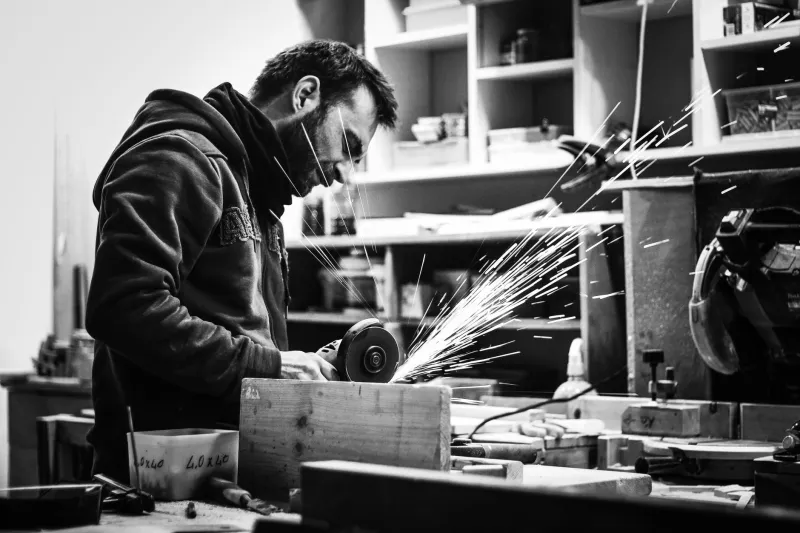
There is a moment familiar to nearly every serious craftsperson — the moment when a faster method, a newer material, or a more efficient tool presents itself, and the maker must decide whether adopting it represents progress or surrender. It is rarely a comfortable decision. And it is almost never a simple one.
Across the United States, workshops engaged in everything from hand-forged ironwork to bespoke furniture joinery are confronting this tension with increasing urgency. The forces pressing against tradition are not merely technological. They are economic, generational, and philosophical. To understand how the most thoughtful artisans are navigating this landscape is to understand something essential about what craft, at its finest, actually is.
The Weight of Inherited Method
Tradition in craft is not sentimentality. It is accumulated intelligence. When a blacksmith draws metal using a technique refined over centuries, that method encodes hard-won knowledge about heat behavior, grain structure, and the physical relationship between tool and material. To discard it casually is not liberation — it is a kind of forgetting.
This is a point that experienced makers emphasize with some consistency. The old ways often persist not because no one thought to question them, but because repeated questioning confirmed their value. A hand-cut dovetail joint, for instance, is not merely decorative. Its geometry distributes stress in ways that have proven durable across lifetimes of use. The technique survived not through nostalgia but through performance.
Yet tradition can also calcify into ritual. Methods that were once the most practical available sometimes persist simply because they were always done that way — because questioning them felt disloyal to the lineage of makers who came before. Distinguishing between these two kinds of tradition — the load-bearing and the merely habitual — is among the most demanding intellectual tasks a craftsperson faces.
What Innovation Actually Means on the Shop Floor
The word "innovation" carries a particular charge in craft circles, often conjuring images of CNC routers and laser cutters displacing human skill. But the craftspeople making the most considered choices tend to define innovation more precisely than that.
For many, the meaningful question is not whether a tool is new, but what role it plays in the making process. A bandsaw used to rough-cut lumber before hand-planing the final surface is doing something categorically different from a computer-controlled mill that produces a finished component without human intervention. In the first case, a machine handles preparatory labor so that the craftsperson's time and attention can be concentrated where human judgment matters most. In the second, the human has largely stepped back from the act of making.
Workshops that have found a workable balance tend to apply a consistent internal logic: modern methods are welcome where they reduce fatigue, improve safety, or eliminate genuinely low-value repetition. They are resisted where they would replace the judgment, touch, or decision-making that gives a handcrafted object its essential character.
A ceramics studio in western North Carolina, for example, uses a pugmill to prepare clay bodies — a task that is physically demanding and offers no creative return — while insisting that every piece be thrown, trimmed, and glazed entirely by hand. The machine serves the maker. The maker remains sovereign over the work.
The Apprentice's Actual Dilemma
Younger craftspeople entering established workshops often arrive with a different relationship to technology than their mentors. They have grown up in an environment where digital tools feel natural, where efficiency is a virtue, and where the friction of older methods can seem arbitrary rather than meaningful. This generational gap is real, and it produces genuine tension.
But it also produces something valuable: the right questions asked without deference. An apprentice who asks why a particular step is done a particular way is not being disrespectful. They are doing exactly what craft knowledge requires — subjecting received practice to scrutiny. The best master craftspeople recognize this and welcome it, understanding that tradition defended only by authority is tradition already in decline.
The more productive workshops treat this exchange as a collaborative investigation. The experienced maker brings context: the understanding of why a method evolved, what problems it solved, what failures preceded it. The newer maker brings fresh perspective: an eye unclouded by habit, a willingness to question what has gone unquestioned. When this exchange functions well, it produces something neither party could reach alone.
Distinguishing Signal from Noise
Not every new tool or method deserves serious consideration, and not every traditional practice deserves defense. The craftspeople navigating this terrain most successfully seem to share a particular discipline: they evaluate changes against outcomes rather than against principle.
The central question they ask is not "Is this traditional?" or "Is this modern?" It is: does this change affect what the customer experiences when they hold, use, or live with this object? If a process modification is invisible in the finished work — if it neither improves nor diminishes the quality, durability, or character of the piece — it may simply be a matter of operational preference. If a change would alter the object's essential nature, even subtly, it demands much more careful consideration.
This outcome-oriented thinking also protects against a different kind of error: the romanticization of difficulty. Some makers resist modern methods not because those methods would compromise quality, but because the struggle of older techniques feels integral to their identity as craftspeople. This is understandable as a personal choice. As a business philosophy, however, it can become a liability — adding cost and time without adding value to the customer's experience.
A Living Conversation
What is perhaps most striking about the workshops engaging seriously with these questions is that they have not resolved them permanently. The conversation is ongoing, revisited as new tools emerge, as materials evolve, and as the craftspeople themselves develop. The decision made about a particular technique five years ago may be reconsidered today — not because the original decision was wrong, but because circumstances have changed.
This willingness to remain in dialogue with the question, rather than settling it once and moving on, may itself be the most important inheritance that craft tradition offers. The great workshops of the past were not static. They adapted, absorbed, and evolved — while holding firm to the standards that defined their work at its best.
The craftspeople doing this most thoughtfully today are not choosing between tradition and innovation. They are choosing, with care and deliberation, which parts of each deserve a place in the work they are building to last.