Vanishing Hands: The Crisis Quietly Dismantling American Craft Trades
A Tradition Interrupted
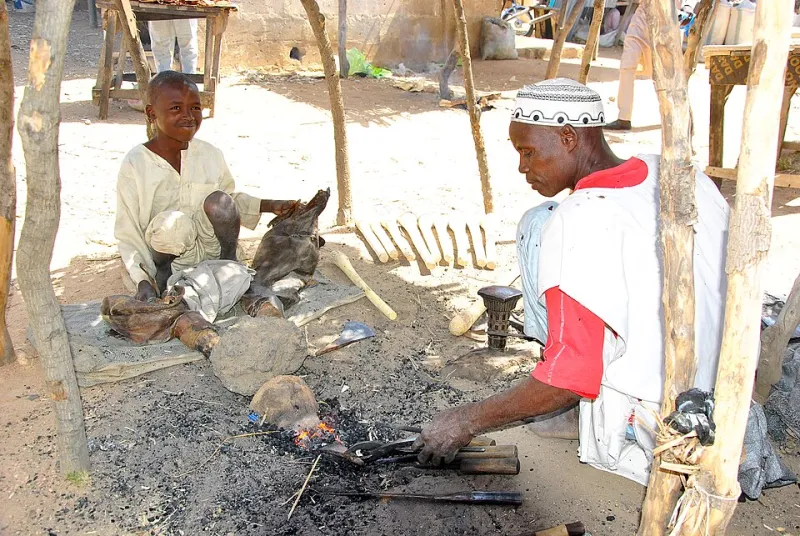
There is a particular kind of knowledge that cannot be downloaded. It lives in the hands—in the calibrated pressure applied to a hammer, the intuitive read of grain direction in a piece of hardwood, the near-imperceptible adjustment a blacksmith makes when the steel begins to cool too quickly. This knowledge is transmitted slowly, imperfectly, and irreplaceably through proximity: one person watching another, then doing, then failing, then improving over months and years.
For most of American history, that transmission happened through apprenticeship. Young men and women entered workshops, foundries, and studios not as students in any formal sense, but as understudies—absorbing craft through sustained observation and guided practice. The system was inefficient by modern standards, and it demanded patience from both parties. But it worked. It produced generations of makers whose competence was not theoretical but embodied.
That system is now in serious distress.
How the Pipeline Narrowed
The decline did not happen overnight, nor did it result from any single policy or cultural moment. It accumulated across decades, shaped by intersecting pressures that each seemed reasonable in isolation.
Beginning in earnest during the latter half of the twentieth century, American secondary education shifted its emphasis decisively toward college preparatory curricula. Vocational programs—woodshop, metalworking, drafting, ceramics—were gradually defunded or eliminated entirely in school districts from rural Pennsylvania to suburban California. The message, however unintentional, was clear: working with one's hands was a consolation prize for those who could not manage an academic path.
At the same time, manufacturing itself underwent profound restructuring. As production moved offshore and automation absorbed more factory floor roles, the cultural prestige attached to skilled trades eroded. The master craftsman who had once commanded respect and a comfortable livelihood found his trade undervalued in a market that increasingly rewarded speed and volume over precision and durability.
The result, according to data from the U.S. Bureau of Labor Statistics, is a workforce gap in skilled trades that now runs into the hundreds of thousands. Organizations such as the Manufacturing Institute have documented consistent shortfalls in positions requiring hands-on expertise—and the problem is compounding as the existing generation of master craftspeople ages toward retirement.
The Economic Barrier No One Discusses Enough
Beyond culture, there is a financial reality that makes apprenticeship difficult to revive even when the will exists. For a small workshop or independent forge, taking on an apprentice is an act of significant generosity. The apprentice produces little of commercial value for months, sometimes years. The master spends time teaching that would otherwise generate income. And unlike formal employment, the arrangement offers few legal protections or standardized compensation structures.
In many European countries—Germany and Switzerland most prominently—dual-track apprenticeship systems are subsidized by government and structured by industry guilds, making the economics workable for both parties. The United States has no equivalent infrastructure at scale. The Registered Apprenticeship Program administered by the Department of Labor exists, but participation among artisanal trades remains limited, and awareness among small makers is inconsistent.
The aspiring craftsperson faces parallel obstacles. Without access to a paid apprenticeship, learning often means enrolling in expensive trade programs or absorbing the cost of self-directed study. For those without family wealth or institutional support, the entry barrier is simply too high.
Workshops Refusing to Surrender
And yet, not everyone has accepted this trajectory as inevitable.
Across the country, a scattered but determined cohort of workshops and studios has chosen to revive the mentorship model—sometimes formally, often informally, always with intention. In the Pacific Northwest, small furniture studios have begun partnering with community colleges to create hybrid programs that combine classroom instruction with genuine shop-floor apprenticeship. In Appalachia, blacksmithing cooperatives have structured tiered membership systems that allow newer makers to learn alongside established smiths in exchange for contributed labor.
Some of the most compelling examples are the smallest. Individual makers who have achieved mastery in a given discipline—whether leather goods, hand-forged ironwork, or handbuilt ceramics—have begun deliberately carving out time in their production schedules to bring one or two apprentices through a multi-year learning arc. These arrangements are rarely profitable in the short term. They are investments in a longer continuity.
What these workshops share is a conviction that craft knowledge is a commons—something that belongs not to the individual maker but to the broader culture of making, and that must therefore be actively transmitted rather than hoarded or allowed to expire.
Why This Matters Beyond the Workshop
It would be easy to frame the apprenticeship gap as a concern only for those who make things professionally. It is, in fact, a concern for everyone who uses things.
When the skilled workforce thins, the capacity to produce goods of genuine quality contracts with it. What remains is a market increasingly dominated by objects that are manufactured quickly, designed for obsolescence, and incapable of being repaired. The consumer who would prefer a well-made chair that will outlast three generations of poor-quality alternatives finds fewer and fewer craftspeople capable of building it.
Preserving apprenticeship is, in this sense, an act of consumer protection as much as cultural preservation. It sustains the possibility of excellence—the option to choose something made by someone who spent years learning how to make it well.
At Voitheia Forged, this is not an abstract concern. The objects we celebrate and the makers we admire exist within a tradition that requires active stewardship. The forge does not sustain itself. Neither does the knowledge that makes it productive.
A Reckoning Worth Having
The apprenticeship gap is not a problem with a simple solution, and any honest accounting must acknowledge the difficulty of what revival requires. It demands that makers sacrifice short-term productivity for long-term continuity. It demands that institutions—schools, government agencies, industry associations—treat craft trades as worthy of serious investment. And it demands that consumers recognize their own role: every purchase of a handcrafted object is, in a small but real way, a vote for the continuation of the skills that produced it.
The hands that shape durable things must themselves be shaped. That shaping takes time, mentorship, and a cultural willingness to regard the work as worth doing. Whether enough Americans retain that willingness is, at this particular moment, an open question—and one with consequences that will be felt long after the current generation of master craftspeople is gone.