The Craftsman's Blueprint: Enduring Business Lessons from the Workshop Floor
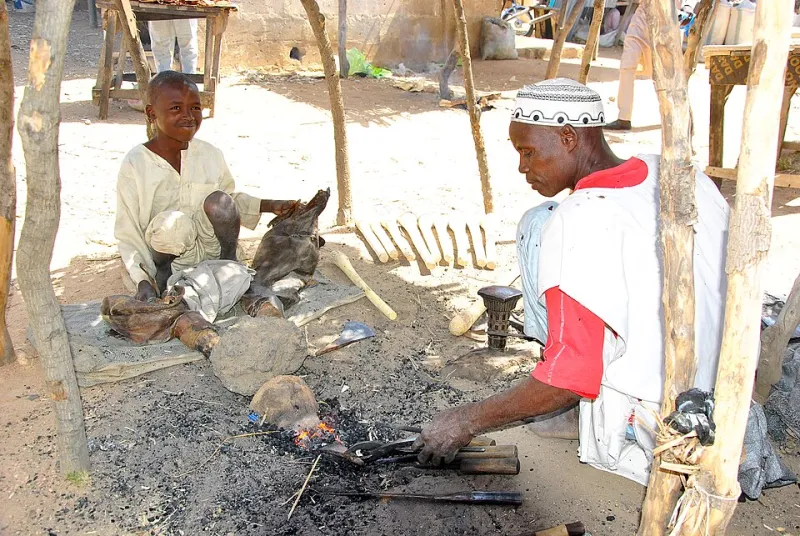
Photo: master craftsman workshop hands forging metal tools leadership, via emprendedor.com
The master craftsperson and the chief executive appear to occupy entirely different worlds. One works with hands and tools; the other navigates boards, balance sheets, and organizational complexity. Yet the principles that allow a craftsperson to build objects that outlast generations bear a striking resemblance to the principles that allow a company to outlast its competitors. The workshop floor has more to teach the corner office than most executives have been willing to admit.
Slowness Is Not Inefficiency
One of the most persistent misunderstandings in modern business culture is the conflation of speed with progress. Quarterly pressure, rapid iteration cycles, and the cultural glorification of the pivot have produced an environment in which moving quickly is treated as a virtue independent of direction. The results are visible everywhere: products rushed to market before they are ready, cultures built on urgency rather than purpose, and companies that grow fast and collapse faster.
A master craftsperson operates from a fundamentally different premise. The deliberate pace of handwork is not a limitation to be overcome — it is the mechanism through which quality is achieved. When a blacksmith shapes a piece of iron at the forge, the repeated heating, striking, and assessment is not inefficiency. It is the process by which error is caught, form is refined, and the final object earns its integrity. Rushing any stage does not accelerate progress; it embeds flaws that compound over time.
The business parallel is direct. Companies that have endured for decades — firms like Patagonia, S.C. Johnson, and Tiffany & Co., each with histories measured in generations rather than funding rounds — share a notable characteristic: they have consistently prioritized the quality of their decisions over the speed of their execution. They have been willing to move deliberately, to test thoroughly, and to resist the pressure to ship something simply because the calendar demanded it.
Slowness, in this context, is not a failure of ambition. It is an expression of accountability.
The Standard Lives in the Maker's Hands
In a traditional craft workshop, quality control is not a department. It is a disposition. The craftsperson who shapes, joins, and finishes a piece is also the person who inspects it, who identifies its weaknesses, and who decides — sometimes painfully — that it does not yet meet the standard. This accountability is not distributed across a hierarchy. It is personal.
This is a model that most modern organizations have systematically dismantled. The separation of design from production, production from quality assurance, and quality assurance from customer accountability has created systems in which no single person is truly responsible for the thing that reaches the customer. Accountability becomes diffuse, and diffuse accountability produces mediocrity at scale.
Leaders who have built genuinely durable organizations tend to resist this diffusion. They remain close to the product — not as micromanagers, but as craftspeople in their own right. Howard Schultz returning to Starbucks in 2008 and personally retraining baristas is a well-documented example. The act was symbolic, certainly, but it was also substantive: a reassertion that the standard lived in the hands of the people doing the work, and that leadership's job was to hold that standard rather than simply report on it.
The master craftsperson never outsources the final judgment. Neither, ultimately, can the leader who wants their organization to produce work worth keeping.
Iteration Without Abandonment
There is an important distinction between the craftsperson's approach to iteration and the technology industry's celebrated concept of the pivot. The craftsperson refines. The pivot, as commonly practiced, discards.
When a skilled woodworker adjusts the angle of a joint, she is not abandoning her design — she is deepening her understanding of it. Each iteration builds on accumulated knowledge rather than rejecting it. The form evolves, but the intention remains stable. This is how craft traditions have survived centuries: not by reinventing themselves at each generation, but by passing forward what works and refining what doesn't, with patience and discipline.
Organizations that have demonstrated genuine longevity tend to iterate in this mode. They revise without erasing. They update without abandoning the core proposition that made them worth caring about in the first place. The companies that cycle through complete identity reinventions every few years — new mission statements, new brand architectures, new strategic priorities — rarely build the kind of institutional memory that produces lasting work. They are, in craft terms, starting from scratch each time, which means they never develop the accumulated skill that comes from sustained practice.
Building for the Person Who Comes After
Perhaps the most profound lesson the craftsperson offers the executive is the orientation toward time. A maker who builds a piece of furniture, forges a tool, or throws a pot with genuine care is building for a future they may not inhabit. The object is intended to outlast the transaction, the trend, and in many cases, the maker themselves.
This is a fundamentally different relationship with time than the one most corporate cultures encourage. Quarterly earnings cycles, annual performance reviews, and short-tenure leadership arrangements all push organizational attention toward the near term. The long term becomes someone else's problem — a successor's inheritance rather than a current responsibility.
The craft tradition refuses this evasion. The apprentice who will one day lead the workshop is watching. The customer who will pass the piece to their children is trusting. The reputation that took decades to build can be lost in a single season of compromised standards. These are not abstract concerns. They are the daily context in which the craftsperson makes decisions, and they produce a quality of attention that purely short-term incentive structures cannot replicate.
A Different Kind of Leadership
None of this is to suggest that running a company is the same as running a workshop. Scale introduces complexities that no individual craftsperson navigates. The point is not equivalence but orientation.
Leaders who have adopted something like the craftsperson's orientation — who take personal accountability for quality, who resist the pressure to ship before something is ready, who build institutional practices designed to outlast their own tenure — tend to produce organizations that people are proud to be part of and products that people are reluctant to discard.
That is, ultimately, what craftsmanship produces: objects and institutions worth keeping. In a culture increasingly oriented toward disposability, that is not a modest ambition. It is a radical one.