Earned Beauty: Why the Marks of Time Make Handcrafted Objects More Valuable, Not Less
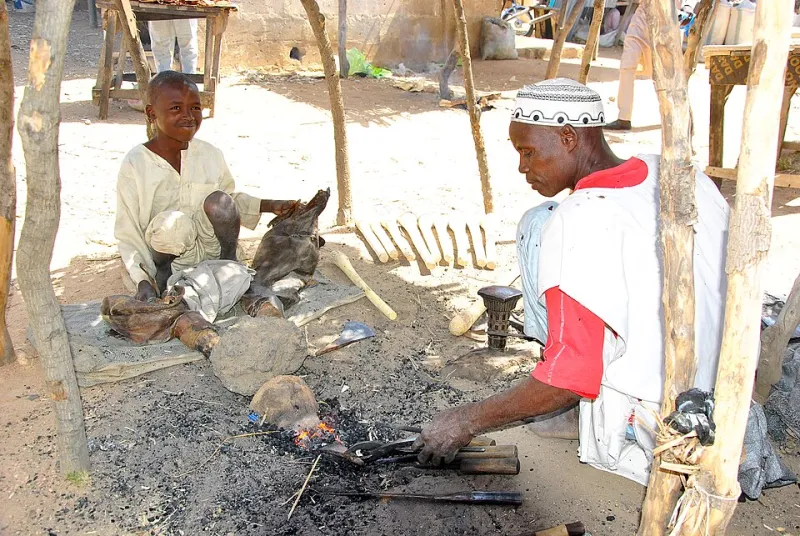
Photo: aged patina handcrafted metal tools worn leather close up detail, via mackenziechildsblog.com
There is a particular moment that many owners of handcrafted goods describe with surprising emotion: the first scratch. Whether it appears on a hand-forged carbon steel knife, a leather-wrapped journal, or a copper vessel, that initial mark can trigger a reflexive disappointment — a wish that the object had remained as pristine as the day it arrived. And yet, among those who truly understand artisanal craftsmanship, that same scratch is the beginning of something far more interesting than perfection.
It is the beginning of a record.
The Problem With Pristine
American consumer culture has long equated newness with value. Retail environments are engineered around the concept of the "unboxing" — the theatrical reveal of an object in its most immaculate state. Protective films remain on surfaces longer than necessary. Furniture is treated with chemical coatings designed to resist any evidence of contact. The implicit message is clear: the moment something shows use, it has diminished.
This philosophy is not accidental. It serves the interests of a disposable economy. If consumers believe that wear equals worthlessness, they replace rather than repair. They discard rather than maintain. The cycle accelerates, and the connection between a person and an object remains permanently shallow.
Handcrafted goods operate on an entirely different premise — one that requires a fundamental shift in perspective for buyers accustomed to mass-market expectations.
What Patina Actually Communicates
Patina, in its most precise definition, refers to the surface transformation that occurs on metals, leathers, and certain woods through oxidation, contact, and exposure over time. On copper, it produces the distinctive verdigris seen on historic American landmarks like the Statue of Liberty. On carbon steel, it manifests as a darkening that actually strengthens the metal's resistance to rust. On vegetable-tanned leather, it deepens the color and increases suppleness in ways that synthetic treatments can never replicate.
But patina communicates something beyond chemistry. It communicates authenticity.
"When I hand someone a piece that has been used for ten years, the surface tells you everything," says one blacksmith based in western Pennsylvania who has been forging tools and cookware for nearly two decades. "You can see where the grip falls naturally. You can see how the owner cooks, what they reach for most. That's not damage. That's a portrait."
This perspective is shared broadly among makers who work with materials that age visibly. They design not merely for the object's appearance at the moment of sale, but for its appearance a decade into honest use.
Designing for Graceful Aging
The concept of designing for age — sometimes called "graceful degradation" in engineering circles — is taken seriously by skilled artisans who consider a product's entire lifespan before the first hammer falls or the first stitch is pulled.
A well-forged blade, for instance, is shaped with a geometry that distributes wear evenly along the edge rather than concentrating stress at a single point. This means that even after years of sharpening, the blade retains its functional profile. The visual evidence of sharpening — a slightly narrowed spine, a refined bevel — becomes a testament to use rather than a sign of neglect.
Similarly, hand-stitched leather goods are constructed with thread tension and wax finishing techniques that allow the leather to move and breathe without the stitching pulling apart. As the leather darkens and softens, the stitching holds firm, often becoming more visually prominent and beautiful as the contrast between aged leather and waxed thread deepens.
"I think about the object at year fifteen," says an artisan leather worker based in Nashville who produces custom belts and holsters. "If I can imagine it looking better at year fifteen than it did at year one, I've done my job. If I can't, I go back to the bench."
The Contrast With Mass Production
The distinction becomes sharper when placed alongside mass-produced alternatives. A stamped stainless steel pan coated with nonstick polymer degrades on a timeline measured in months. The coating chips, the surface becomes uneven, and the object enters a state of functional and aesthetic decline from which there is no recovery. It cannot be restored. It can only be discarded.
A hand-forged cast iron or carbon steel pan, by contrast, improves with use. Each cooking session deposits a thin layer of polymerized oil into the microscopic pores of the metal, building a natural, durable cooking surface that becomes more effective — and more beautiful — over time. The dark, almost lacquered appearance of a well-seasoned pan is not evidence of age in the pejorative sense. It is evidence of mastery, both by the maker and the owner.
This is the central irony that disposable consumer culture has obscured: the object that shows its age gracefully is almost always the object that was made to last.
A New Relationship With Objects
Embracing the philosophy of earned beauty requires a shift that is as much psychological as aesthetic. It asks buyers to invest not merely money, but attention and care. It asks them to see themselves as participants in the ongoing life of an object rather than simply its temporary custodians.
In practical terms, this means learning the specific maintenance rhythms of the materials one owns. Carbon steel requires occasional oiling. Leather benefits from periodic conditioning. Certain woods respond to seasonal humidity changes and should be treated accordingly. These are not burdens. They are rituals — small, deliberate acts of stewardship that deepen the relationship between a person and the things they choose to keep.
The reward for that investment is an object that carries genuine personal history. A hand-forged hatchet that has cleared brush on a family property in Vermont for thirty years is not merely a tool. It is a document. Its worn handle, its re-profiled edge, its patinated head — these are marks of a life actively lived.
The Standard Voitheia Forged Holds
At Voitheia Forged, the commitment to handcrafted permanence is inseparable from an understanding that true quality reveals itself not at the point of sale, but across years of honest use. The makers whose work we celebrate are those who design with time as a collaborator — who understand that the finest endorsement any object can receive is the evidence of a life well shared with its owner.
The scratch, the darkened grip, the softened leather, the seasoned steel: these are not flaws. They are the language in which a well-made object speaks its own history. Learning to read that language is one of the quiet pleasures of choosing craft over convenience.