Iron, Identity, and Intention: How a New Generation Is Reclaiming the Forge
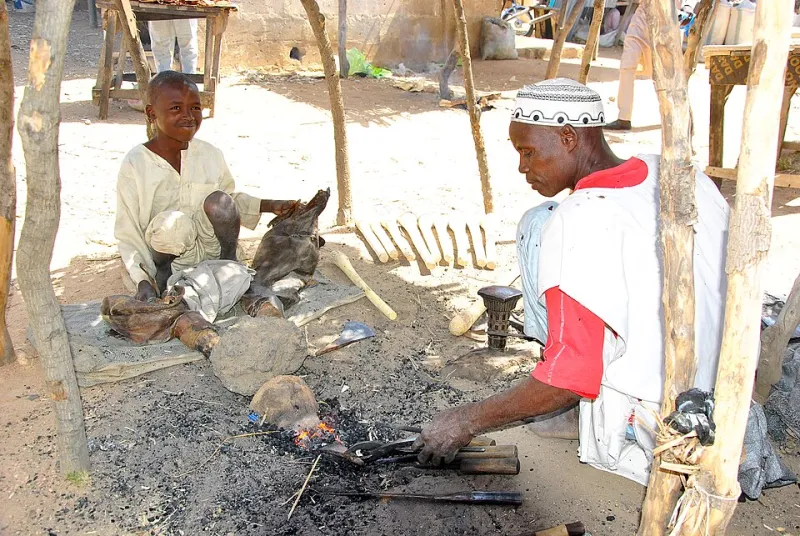
Photo: Muhdeen, CC BY-SA 4.0, via Wikimedia Commons
When the Digital World Leaves You Empty-Handed
There is something profoundly disorienting about spending eight hours producing work that exists only as pixels on a screen. For a growing number of Americans born between 1981 and 2012, that disorientation has become a catalyst. They are walking away from their desks — if only for evenings and weekends — and walking toward something far older: the forge.
Blacksmithing, one of the foundational crafts of human civilization, is experiencing a measurable revival in the United States. Enrollment in metalworking and blacksmithing courses at community colleges, craft schools, and private studios has climbed steadily over the past decade. The Artist-Blacksmith's Association of North America (ABANA) has reported consistent increases in membership inquiries from practitioners under the age of 35. What was once perceived as a dying trade has become, for many younger Americans, an act of deliberate cultural reclamation.
The Forge as Counterculture
To understand why millennials and Gen Z are drawn to blacksmithing, it helps to understand what they are moving away from. This is a generation that came of age amid accelerating automation, gig-economy precarity, and the relentless churn of social media. They have inherited a consumer culture built on planned obsolescence — products designed to fail, to be discarded, and to be replaced.
Blacksmithing offers a direct and visceral rebuttal to all of that.
"There's nothing abstract about what I do," says Marcus Dellaway, a 29-year-old smith based in Asheville, North Carolina, who left a career in software development to apprentice under a master metalworker. "When I finish a piece — a knife, a gate hinge, a fireplace tool — I can hold it. It has weight. It will outlast me. That's not something you can say about an app."
Dellaway's sentiment is widely shared. Across communities from rural Montana to urban Philadelphia, younger smiths describe the forge not as an escape from modernity but as a correction of it. They are not rejecting technology wholesale; many use computer-aided design software to plan complex decorative work or leverage social media to sell their output. What they are rejecting is the idea that making something with your hands is somehow less valuable than producing something with a machine.
The Therapeutic Weight of Real Work
Beyond ideology, there is a deeply personal dimension to this revival. Mental health professionals and craft educators alike have noted that repetitive, physically demanding, skill-based work offers psychological benefits that are difficult to replicate through conventional therapy or digital wellness tools.
Dr. Lena Hartfield, an occupational therapist who works with veterans and young adults experiencing anxiety disorders at a clinic in Denver, Colorado, has incorporated metalworking into her practice. "The forge demands absolute presence," she explains. "You cannot be ruminating about tomorrow when you are managing a 2,000-degree fire and shaping steel. The work pulls you entirely into the present moment. For many of my patients, that quality of focused attention is something they have never experienced before."
This therapeutic dimension is not incidental to the craft's appeal — it is central to it. Practitioners consistently describe a state that psychologists term "flow": the complete absorption in a challenging task that produces both competence and calm. In a culture saturated with distraction, the forge offers something rare — a space where divided attention is simply not possible.
Mentorship, Community, and the Passing of Knowledge
One of the most compelling aspects of this revival is its social architecture. Unlike many solitary hobbies, blacksmithing has traditionally been transmitted through direct mentorship — master to apprentice, hand to hand. That lineage is being actively reconstructed.
In towns across Appalachia, the Pacific Northwest, and the upper Midwest, informal networks of smiths have formed around shared studio spaces, communal kilns, and regional hammer-ins — gatherings where smiths of all skill levels convene to demonstrate techniques, exchange knowledge, and celebrate the work itself. These gatherings carry a communal warmth that participants describe as almost anachronistic in the best possible sense.
"I drove six hours to a hammer-in in rural Tennessee last spring," recalls Priya Venkataraman, a 33-year-old architectural designer who has been smithing for four years. "I was one of maybe three women there out of forty people, and I expected to feel out of place. Instead, an 70-year-old smith from Kentucky spent three hours teaching me a scroll technique he'd learned from his grandfather. That kind of generational transmission — it's rare. It matters."
For Voitheia Forged, this exchange of embodied knowledge represents the living core of artisanal craft. A handmade object carries within it not only the skill of its maker but the accumulated wisdom of every teacher who contributed to that maker's formation. That is a form of heritage that no factory process can replicate.
What the Market Is Telling Us
The resurgence of blacksmithing is not occurring in a vacuum. It reflects and reinforces a broader shift in consumer values among younger Americans. Research from the Edelman Trust Barometer and various craft industry surveys consistently shows that millennials and Gen Z place higher premiums on provenance, sustainability, and craftsmanship than their predecessors. They want to know who made something, how it was made, and whether it will endure.
This represents a significant market realignment. Artisanal metalwork — custom knives, hand-forged hardware, bespoke furniture components, and sculptural ironwork — commands premium prices precisely because it offers what mass production cannot: singularity, accountability, and longevity. A hand-forged knife from a skilled American smith may cost ten times what a factory blade does. It may also last ten lifetimes.
The Forge as a Statement of Values
At its deepest level, the return to blacksmithing among younger Americans is a statement about what kind of world they wish to inhabit and what kinds of objects they wish to surround themselves with. It is a rejection of the notion that speed and efficiency are the only virtues worth honoring in the production of goods.
The forge is slow. It is hot, physically demanding, and unforgiving of inattention. It produces objects one at a time, each bearing the subtle marks of the hands that shaped them. And that, it turns out, is precisely the point.
At Voitheia Forged, we recognize in this movement something that has always been central to our own philosophy: that the act of making something well — with skill, with patience, with genuine care for the person who will ultimately hold it — is not merely a production method. It is an ethical stance. It is a form of respect, paid forward through iron and fire, across generations.
The forge is not going anywhere. And neither, it seems, are the people who have chosen to stand before it.