What the Material Knows: The Unspoken Dialogue at the Heart of True Craftsmanship
The Instruction No Manual Carries
There is a moment, familiar to anyone who has spent serious time at a workbench, when the tool in hand stops being the primary point of attention. The grain of the wood, the flex of the leather, the cooling behavior of the metal—these become the dominant voice in the room. The maker's job, at that point, is no longer to impose a plan. It is to listen carefully enough to revise one.
This is not mysticism. It is a form of applied intelligence that develops slowly, through accumulated hours of failure and correction, until a craftsperson's hands and eyes carry knowledge that their conscious mind cannot fully articulate. In the American craft tradition—whether in the blacksmith shops of rural Appalachia, the furniture workshops of New England, or the leatherworking studios of the Southwest—this capacity has always been understood as the mark of a maker who has genuinely arrived. It is also, increasingly, the quality that industrial processes cannot replicate regardless of how sophisticated their programming becomes.
A Literacy Built From Resistance
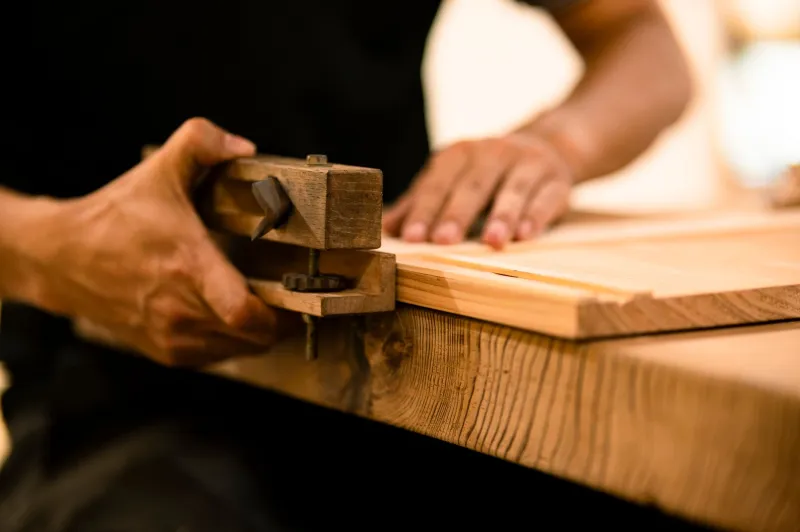
Material literacy does not begin as sensitivity. It begins as resistance. The novice woodworker encounters grain that tears rather than planes smooth, and the instinct is to apply more force, to blame the tool, or to assume the piece is simply defective. The experienced maker pauses. They examine the angle of the grain, consider the species, perhaps hold the board up to a raking light to understand what is actually happening beneath the surface. Then they adjust—the direction of the stroke, the sharpness of the blade, the moisture content they are willing to tolerate before proceeding.
The same dynamic plays out across every medium. A metalsmith working with copper learns that the material work-hardens as it is shaped, becoming progressively more resistant to forming and eventually brittle if not annealed. Missing that signal—failing to recognize when the metal is telling you it needs heat and rest before further work—results in cracking, loss of material, and lost time. Reading it correctly, by learning what the surface looks like and what the hammer's feedback feels like when hardening has progressed too far, is knowledge that accumulates in the hands as much as in the head.
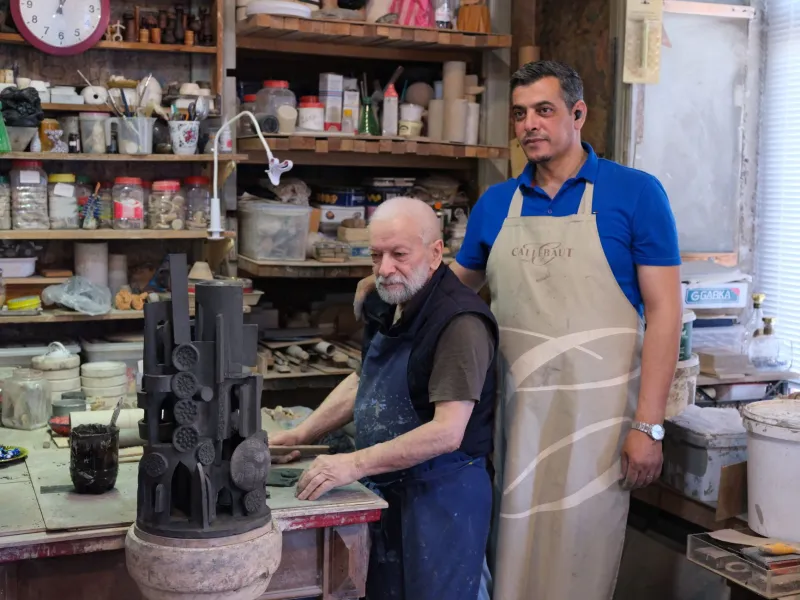
Clay potters speak of this in terms of the clay's memory. A body that has been worked in one direction retains a kind of structural bias; push against it carelessly and the piece will warp in the kiln, often in ways that seem inexplicable until the maker reconstructs every handling decision made before the firing. Leather craftspeople describe a similar phenomenon when discussing how a hide's natural stretch orientation must be respected in pattern cutting, or the finished piece will deform under use in ways no amount of stitching can correct.
In each case, the material is not passive. It carries its own history—of growth, stress, processing, and handling—and it communicates that history to anyone patient enough to notice.
The Danger of Overconfidence
There is a particular hazard that arrives mid-career, when a craftsperson has accumulated enough experience to work with genuine fluency but not yet enough humility to recognize the limits of their pattern recognition. At this stage, the maker may begin to treat new material as though it will behave exactly like every previous example of its type. A walnut board is a walnut board; copper is copper; a side of vegetable-tanned leather will respond as all the others have.
Experienced makers who have pushed through this phase will often describe a humbling correction—a piece that failed in an unexpected way, a commission that went wrong despite competent execution, a material batch that behaved differently than anticipated. These episodes are not failures of technique so much as failures of attention. The material was communicating something the maker had stopped listening for.
This is why the most accomplished artisans tend to describe their relationship with their medium in terms of ongoing negotiation rather than mastery. The word mastery implies a fixed summit; the reality of working with natural materials is that the conversation never fully closes. Wood moves with seasonal humidity changes. Metal alloy compositions vary between suppliers. Hides differ by animal, region, and tannery practice. The maker who treats each new piece as genuinely new—approaching familiar material with the attentiveness of a first encounter—preserves the sensitivity that competence can quietly erode.
What This Means for the Objects That Result
The practical consequence of this dialogue is visible in the finished work, though not always in ways a casual observer might identify. A chair built by a maker who listened to the wood will have joinery oriented to work with the material's natural movement rather than against it; decades from now, when a chair built without that attentiveness has loosened and racked, this one will remain tight. A hand-forged blade whose maker read the steel's response during the hardening process will hold an edge in ways that spec-sheet metallurgy alone cannot guarantee. A leather bag cut by someone who understood the hide's character will develop a patina that flows naturally from its structure rather than fighting it.
These are not merely aesthetic outcomes. They are functional ones. The dialogue between maker and material is ultimately a process of building objects that are structurally honest—that do not ask their components to perform in ways those components are not suited to sustain. This is the engineering that lives inside craft, expressed not through calculation but through accumulated sensitivity.
The Irreplaceable Variable
Automated manufacturing can achieve extraordinary consistency. It can hold tolerances that no human hand could maintain across thousands of repetitions. What it cannot do is recognize that a specific piece of material, on a specific day, in a specific state of preparation, is telling the process to change course. The sensor arrays and feedback loops of modern production equipment are designed to enforce a specification, not to negotiate with variance.
The craftsperson does the opposite. They begin with an intention and then remain genuinely open to the possibility that the material will redirect it. Sometimes the redirection is minor—a slight adjustment in pressure, a change in sequence. Occasionally it is substantial: the realization that this particular piece of wood, this hide, this bar of metal, wants to become something different than originally planned, and that following its suggestion will produce a better object than insisting on the original design.
That responsiveness—that willingness to be taught by the material itself—is not a workflow. It is a disposition. It develops over years, through the kind of attentive, repetitive practice that has no shortcut. And it is, in the end, the quality that makes a handcrafted object something more than the sum of its components: the record of a genuine exchange between a human intelligence and the physical world.