The Necessary Quiet: How Solitude Shapes the Craftsperson's Highest Work

There is a particular quality of silence that settles over a workshop in the early morning hours—before the phone begins its demands, before the street outside fills with traffic, before the world reasserts its claim on a maker's attention. Experienced craftspeople often describe this window not as empty time but as the most productive hours of their professional lives. It is within this quiet that the most exacting work happens: the joinery that must be felt as much as measured, the surface that requires a hundred passes of the plane before it yields its final character, the judgment calls that cannot be rushed without consequence.
Yet this silence is increasingly difficult to defend. The same connectivity that allows a small workshop to reach customers across the country also delivers a continuous stream of interruption. The question facing today's serious maker is not whether solitude matters—generations of master craftspeople have answered that question decisively—but how to protect it in a professional landscape that treats availability as a virtue.
What Distraction Actually Costs
The cognitive science here is instructive, even if most experienced makers arrived at the same conclusions long before researchers formalized them. The state psychologist Mihaly Csikszentmihalyi famously described as "flow"—that condition of total absorption in which skill and challenge meet in productive tension—does not arrive on demand. It requires an uninterrupted runway of focused attention, typically measured in tens of minutes, before a craftsperson achieves the depth of engagement where their best work becomes possible.
Every interruption resets that runway. A glance at a notification, a brief exchange with a visitor, a moment spent responding to a message—each of these imposes a recovery cost that the clock does not show. The interruption itself may last thirty seconds. The return to genuine focus may take twenty minutes. For a maker working on a commission that demands sustained judgment—fitting a mortise-and-tenon joint, hand-stitching a leather panel, throwing and trimming a vessel that requires consistent wall tension throughout—these hidden costs accumulate into something far more damaging than lost time. They compromise the quality of perception itself.
Master woodworkers, bladesmiths, and textile artists across the United States frequently cite the same phenomenon: work produced during fragmented attention carries a detectable difference from work produced in sustained focus. Not always visible to the untrained eye, perhaps, but present nonetheless—in a line that wavers almost imperceptibly, in a surface that lacks the final coherence of a fully committed pass, in a proportion that was judged adequately rather than felt completely.
Solitude Is Not Withdrawal
It is worth addressing a misunderstanding that sometimes surrounds this subject. The craftsperson who guards their workshop hours, who does not respond to messages during making time, who closes the door and works without interruption, is not being antisocial or professionally negligent. They are practicing a form of discipline as rigorous as any physical technique.
The American cultural tendency to equate responsiveness with professionalism creates genuine pressure on independent makers. Customers accustomed to instant replies may interpret a delayed response as indifference. Peers who post continuously on social platforms may make deliberate silence feel like a competitive disadvantage. These pressures are real, and they are worth acknowledging honestly.
But the craftsperson who surrenders their focused hours to manage these perceptions is making a trade that ultimately serves no one well. The customer who receives a commission produced in distracted, fragmented sessions is not better served by the maker's constant availability. The work itself is the primary obligation—and the work demands conditions that most forms of modern communication actively undermine.
How Makers Defend Their Creative Sanctuary
The practical strategies that working craftspeople employ to protect their focused time are varied, but several patterns emerge consistently across disciplines and regions.
Establishing fixed hours of unavailability is among the most common approaches. Many makers designate the first two to four hours of their working day as inviolable making time—phones silenced, email closed, studio door shut. Communication is batched into a defined window, typically in the late morning or afternoon, when the most demanding creative work is already done. This structure communicates clearly to clients and collaborators without requiring constant negotiation.
Physical separation of the workspace reinforces the psychological boundary. Makers who work from home often describe the challenge of a studio that exists within the same walls as domestic life and its attendant demands. Those who can establish even a modest physical threshold—a separate building, a clearly defined room with a door that closes, a space that signals to household members that entry requires genuine necessity—report meaningfully better results in sustaining deep focus.
Rituals of transition serve a related function. The act of sharpening tools before beginning work, of arranging the bench in a particular order, of reviewing the day's objectives before picking up the first instrument—these are not superstitions. They are cognitive cues that signal to the maker's own nervous system that a different quality of attention is now required. The ritual creates the threshold where the ordinary world ends and the work begins.
Setting honest expectations with customers is perhaps the most professionally consequential strategy. Makers who communicate clearly—at the point of inquiry, in their studio policies, on their websites—that responses come within a defined window rather than immediately tend to attract customers who understand and respect the nature of handcrafted work. The customer who cannot accept a twenty-four-hour response window may not, in fact, be the customer best suited to the made-to-order relationship.
The Workshop as a Protected Environment
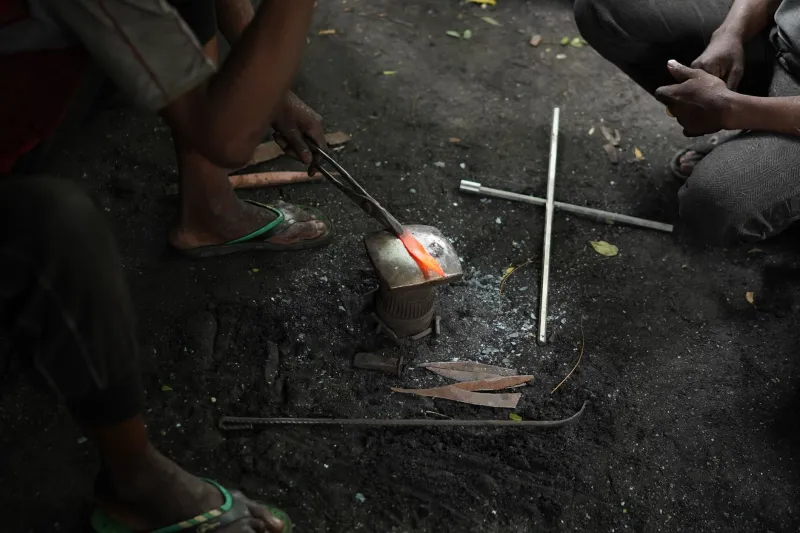
There is something worth considering in the etymology of the word "forge." It carries connotations not merely of physical making but of sustained, effortful transformation—of something being shaped under conditions of intensity and pressure into a form it could not have achieved otherwise. The forge is not a casual environment. It demands complete presence.
This is the quality that handcrafted work carries at its best: the evidence of a maker who was fully present throughout the process of its creation. Customers who seek out artisanal goods, who pay the premium that genuine craft commands, are often responding to something they sense rather than consciously analyze—the coherence that comes from sustained, undistracted attention. They are, in a very real sense, purchasing the quality of the maker's focus as much as the quality of the materials.
Protecting that focus is therefore not a private indulgence. It is a professional responsibility—to the work, to the customer, and to the standards that distinguish genuine craft from its approximations. The silence between strikes is not empty. It is where the maker listens, adjusts, and prepares for the next deliberate action. Remove that silence, and what remains is motion without mastery.
In a world that has grown suspicious of stillness, the craftsperson who defends their quiet hours is making a statement about what work at the highest level actually requires. That statement is, in its own way, as much a part of the craft as anything shaped by hand.