When Knowing Too Much Gets in the Way: The Hidden Struggle of the Master Craftsperson as Teacher
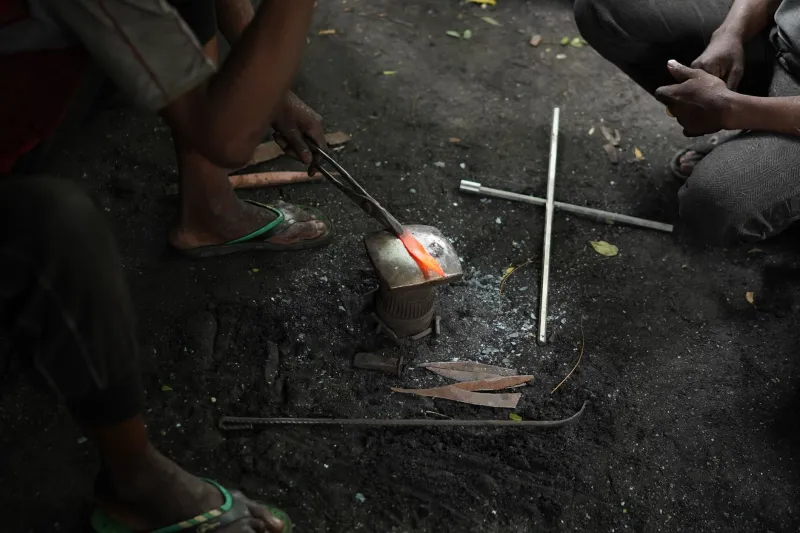
There is a particular kind of silence that settles over a workshop when a master is asked to explain what they just did. The hands pause. The eyes drift slightly upward, as if searching for words in the rafters. Then comes the familiar, almost helpless response: I just knew it was ready.
It is not evasion. It is not arrogance. It is something far more complicated—and far more human.
Across American craft traditions, from the blacksmith shops of the rural Midwest to the woodworking studios of New England, a quiet paradox has long been acknowledged but rarely examined with any rigor. The makers who have spent the most time at their craft—those who have earned the right to be called masters—are frequently the least equipped to teach it. Not because they lack generosity or patience, but because the very nature of deep expertise works against articulation.
The Body Knows Before the Mind Can Speak
Cognitive scientists have a term for what happens when a skill becomes sufficiently practiced: tacit knowledge. It is the kind of understanding that lives not in language but in the body—in the calibrated tension of a wrist, in the almost unconscious reading of a surface texture, in the split-second judgment that tells a glassblower when the gather has reached exactly the right viscosity. Tacit knowledge is, by definition, difficult to transfer through words alone.
For a craftsperson who has spent thirty years at the anvil or the lathe, the gap between knowing and explaining can feel unbridgeable. The neural pathways that govern their most refined movements were laid down so long ago, and have been reinforced so many thousands of times, that conscious thought no longer participates in the process. The skill simply executes itself.
This is, of course, the hallmark of true mastery. But it presents a profound challenge the moment that master stands beside an apprentice and is asked to narrate what the body does automatically.
The Rewiring That Teaching Demands
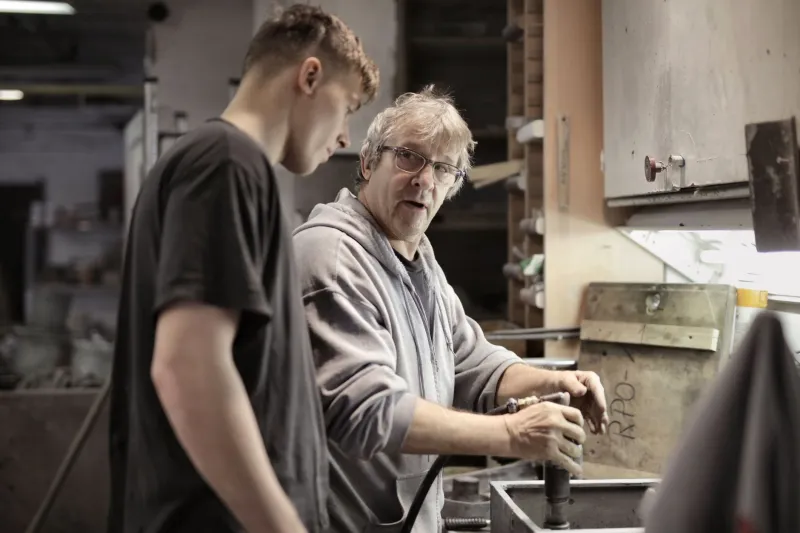
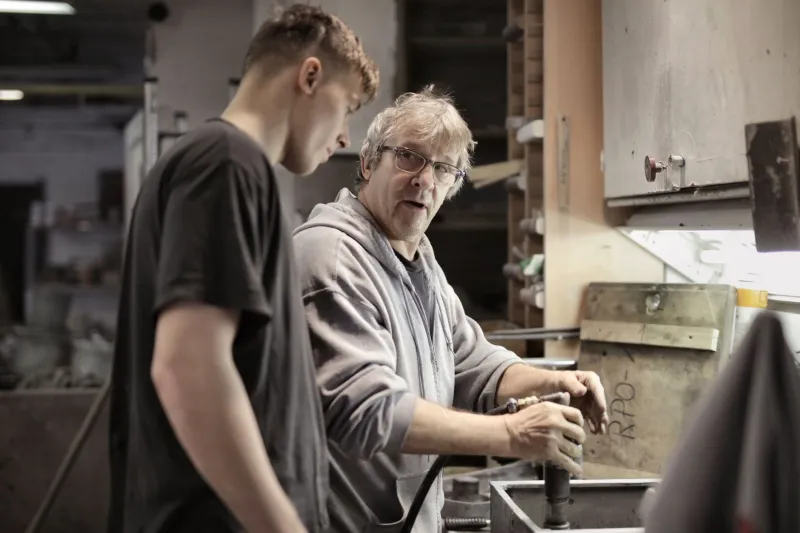
Several experienced mentors working within American craft communities describe the transition into teaching as something close to starting over—not with the craft itself, but with their relationship to it.
One furniture maker with over four decades of experience building hardwood pieces in a small Virginia shop put it plainly: "I had to become a beginner again. Not at the work—at watching myself do the work. There's a difference, and it took me two years to understand that difference."
What he describes is a form of deliberate metacognition—the practice of observing one's own processes from the outside, as a stranger might. It requires a craftsperson to temporarily dismantle the very fluency that defines their expertise, to slow the automatic down to the teachable, to reintroduce conscious attention into movements that no longer need it.
This is not a minor adjustment. For many experienced makers, it is genuinely disorienting. The hand that has always known what to do is suddenly asked to wait while the mind catches up and finds words. Some describe the experience as feeling clumsy, even fraudulent—as though the act of narrating a skill somehow undermines the confidence that makes it possible.
Why Explanation Is Its Own Discipline
The craft of teaching, it turns out, is a separate craft entirely. It borrows from the original discipline but operates according to its own logic. A master blacksmith who has never been required to teach is, in a very real sense, an apprentice instructor—regardless of how many decades of forging experience they carry.
This distinction matters because it reframes what we ask of experienced makers when we invite them into mentorship roles. We are not simply asking them to share what they know. We are asking them to develop an entirely new skill set: the ability to decompose intuition into sequential reasoning, to identify the invisible decision points that their bodies navigate without conscious input, and to translate physical sensation into language that a newcomer can act upon.
Not every master is willing to undergo that process. Some find it frustrating. Others find it genuinely threatening to their sense of identity—a reminder that expertise in one domain does not confer expertise in all related ones. And a few, perhaps the most honest among them, simply acknowledge that they do not know why they do what they do. They only know that it works.
The Apprentice's Unexpected Role
What emerges from conversations with both mentors and apprentices is that effective craft transmission is rarely a one-way transfer. The apprentice, far from being a passive recipient, often serves as a kind of mirror—their confusion and their questions forcing the master to examine assumptions that have gone unexamined for years.
"My apprentice asked me why I always let the piece cool before I moved it to the next stage," recalled one metalworker from a small-batch production shop in Ohio. "And I realized I couldn't answer him. I'd been doing it for so long that I'd stopped asking myself why. We figured it out together, and honestly, I think I understand my own process better now than I did before he started asking."
This dynamic—the teacher learning through the act of teaching—is one of the more underappreciated benefits of the mentorship model. When a master is compelled to reconstruct their understanding from the ground up, they often discover refinements, redundancies, and even errors that decades of unquestioned habit had concealed.
Preserving What Cannot Be Written Down
The stakes of this challenge extend well beyond any individual workshop. The knowledge held in the hands of experienced American craftspeople represents an irreplaceable cultural and practical inheritance. Much of it has never been formally documented, because for most of craft history, documentation was considered unnecessary. You watched. You practiced. You absorbed.
But as the number of working masters declines and the pool of potential apprentices remains shallow, the pressure to find more effective methods of transmission grows urgent. Some craft organizations have begun experimenting with video documentation, structured apprenticeship curricula, and even biomechanical analysis of master makers' movements—tools that attempt to capture what language alone cannot.
These efforts are valuable. But they are not sufficient substitutes for the slow, patient, often frustrating work of one human being trying to give another human being access to something that lives, stubbornly and beautifully, in the body rather than the mind.
The Willingness to Be Uncomfortable
What distinguishes the master craftspeople who become genuinely effective teachers is not, in the end, an unusual talent for explanation. It is a willingness to sit with discomfort—to tolerate the strange vulnerability of not knowing how they know what they know, and to remain curious about it anyway.
That willingness is itself a kind of craft. It requires patience, humility, and a commitment to something larger than personal mastery: the continuation of a tradition, the survival of a practice, the passing of a torch that has no guarantee of being caught.
The best workshops in America are not merely places where things are made. They are places where understanding is slowly, imperfectly, and sometimes painfully transferred from one pair of hands to another. That transfer—uncertain, inefficient, and irreplaceable—is how craft endures.