Worn Into Partnership: The Lifelong Bond Between Craftspeople and Their Tools
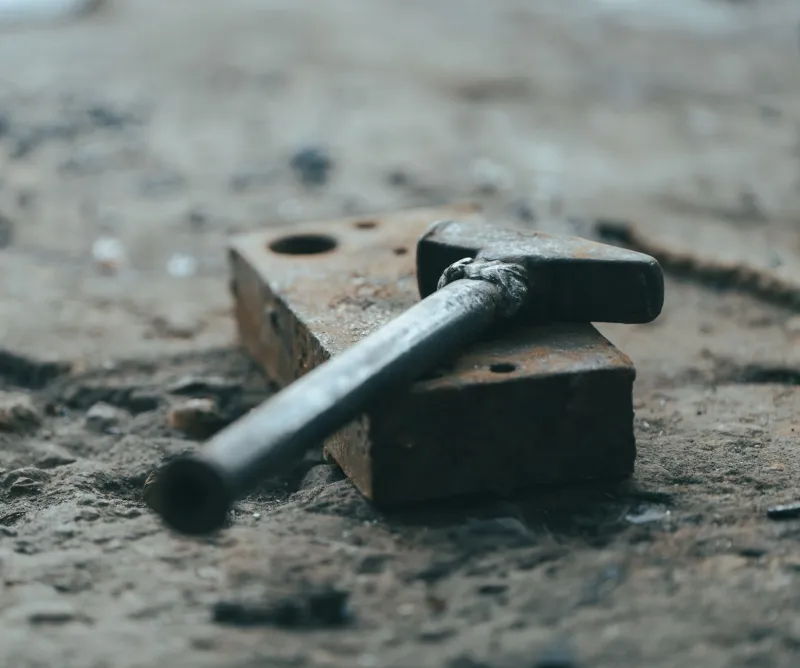
There is a blacksmith in rural Vermont who has been using the same cross-peen hammer for thirty-one years. The handle is not the original—wood wears and splits—but the head, a hand-forged piece of high-carbon steel, has never left his shop. He has been offered newer models, heavier ones, ergonomically redesigned ones. He has declined every time. When asked why, he pauses in the way that craftspeople often do before answering a question they consider almost too obvious to address. "It knows where I'm going," he says, "before I do."
This is not sentimentality, though sentiment is certainly present. It is something more precise, more physiological, and ultimately more illuminating about the nature of skilled making than most manufacturing philosophies dare to acknowledge.
The Body Learns What the Mind Cannot Articulate
Sports scientists and neurologists have long studied the phenomenon of muscle memory—the way repeated physical actions become encoded not merely in conscious recall but in the deeper architecture of motor pathways. A pianist who has practiced a passage ten thousand times does not consciously direct each finger. A carpenter who has driven nails for twenty years does not calculate the arc of the swing. The body has internalized a pattern so completely that conscious thought would only slow it down.
For craftspeople, this internalization is inseparable from the specific object in hand. The weight distribution of a particular hammer, the slight asymmetry of a chisel handle shaped by years of grip, the precise give of a leather strop—these are not incidental details. They are the variables around which an entire physical vocabulary has been constructed. Change the tool, and you do not simply hand the craftsperson something new. You ask them to relearn a language they have spent decades perfecting.
Researchers at institutions studying skilled labor have noted that expert craftspeople often perform significantly worse, at least initially, when switching to unfamiliar tools, even tools of objectively superior quality. The body's expectation—its finely tuned anticipation of resistance, balance, and response—is temporarily violated. The hands know what they know, and what they know is specific.
The Handle That Fits No One Else
Walk into the workshop of any veteran artisan and you will likely find at least one tool that bears the unmistakable signature of long use. A wooden handle polished to a particular sheen where the thumb and forefinger meet. A grip worn slightly thinner on one side, conforming to the habitual angle of a specific wrist. A surface that has absorbed oils, heat, and pressure until it carries a record of every hour it has been held.
This transformation is not merely cosmetic. The worn handle has been shaped by use into something ergonomically precise in a way that no factory production process can replicate, because it has been shaped by one body, over time, performing one set of motions. It fits because it was made to fit—not by a designer, but by repetition itself.
For many craftspeople, this fit becomes a kind of calibration. The tool has adjusted to the hand, and the hand has adjusted to the tool, until the two have arrived at a mutual accommodation so complete that separation feels like amputation. This is not hyperbole. Veterans of skilled trades frequently describe the prospect of retiring a primary tool in terms that mirror the language of loss.
"You don't just lose the object," explains a third-generation cooper in Kentucky whose barrel-making operation still produces by hand. "You lose everything you built with it. It's like losing a record of your own work."
Against the Disposable
American consumer culture is, by design, oriented toward replacement. Products are engineered with planned obsolescence. Durability is frequently sacrificed for cost efficiency. The implicit promise of the marketplace is that the next version will be better, and that attachment to older goods reflects either nostalgia or ignorance of superior alternatives.
The craftsperson's relationship with tools stands in direct opposition to this logic—and does so not out of stubbornness but out of a sophisticated understanding of what value actually means in practice. A tool that has been broken in, calibrated by use, and integrated into a practitioner's physical vocabulary is not merely a functional object. It is an accumulation of expertise made tangible. Replacing it is not an upgrade. It is, in a very real sense, a regression.
This perspective has implications that extend well beyond the workshop. It speaks to a broader question about what we lose when we treat objects as interchangeable and temporary—when we sever the thread of relationship between maker and material, between hand and handle, that has defined skilled work for centuries.
The Tools That Outlast Their Makers
There is another dimension to this bond that deserves consideration: what happens to these tools when the craftsperson is gone.
In many traditions, the primary tools of a master are passed down with the same intentionality as a family heirloom. This is not accidental. A well-made tool, properly maintained, can function across generations. And because it carries the physical imprint of its previous owner—the wear patterns, the subtle modifications, the accumulated character of decades of use—it also carries something of that person's skill and presence.
A young woodworker in Oregon recently described inheriting her grandfather's set of hand planes. She spent months learning to work with them, initially frustrated by the unfamiliar balance and feel. But gradually, she says, something shifted. "I started to understand his movements," she explains. "The way the plane was worn told me something about how he stood, how he angled his body. It was like a lesson he left behind."
This is the deepest form of craft transmission—not the explicit instruction of technique, but the implicit instruction embedded in an object shaped by mastery.
Knowing When to Let Go
None of this suggests that craftspeople are categorically opposed to new tools or improved materials. Most veteran makers are remarkably pragmatic, willing to adopt new instruments when the functional case is clear and the transition period is worth the investment. What they resist is the casual replacement of a tool that still works—particularly one that has been shaped by long relationship into something irreplaceable.
The distinction matters. It is not attachment for its own sake. It is a principled recognition that some forms of value cannot be purchased new, that certain qualities only emerge through time and use, and that the relationship between a skilled hand and a well-worn tool represents something the market cannot manufacture on demand.
At Voitheia Forged, this understanding informs everything we make. We build with the expectation that our pieces will be used, worn, and eventually shaped by the hands that hold them—that the objects leaving our workshop will become, over years and decades, something more particular and more personal than they were when they left. That is not a flaw in the design. It is the design.
The craftsperson who refuses to retire a thirty-year-old hammer is not clinging to the past. He is honoring a partnership built through thousands of hours of shared work. In a culture that defaults to replacement, that kind of fidelity is not weakness. It is wisdom.